Facebook Ads creative testing: structure, budget and cut rules
By Matheus Mello, founder of Ads Editor and owner of YEP Agência · Published · Updated · 12 min read
Facebook Ads creative testing (Meta Ads, these days) answers one question per round: which hook stops the scroll, which promise holds attention, which format converts. The framework below keeps each answer clean and separates the fast decision (cutting losers) from the slow one (crowning a winner).
Quick answer
To test creatives on Meta, use an ABO campaign, 3 to 5 variations per round, about 2x your target CPA per ad set per day and a first read at 48 to 72 hours. Cut anything below your hook, hold and link CTR thresholds, or that spent 2x CPA without converting. Scale the winner in a separate campaign.
Summary
- Test one variable at a time; mixing audience and creative variables produces results nobody can explain.
- ABO for testing: CBO pours budget into whatever looks good in the first few hours.
- Test different concepts first; only then iterate on the winner's hook.
- One creative per ad set gives the cleanest read; several per ad set is cheaper but uneven.
- Cut after 48 to 72 hours; declaring a winner takes more days and more conversion volume.
- Cut when two metrics hit critical (hook below 20%, hold below 25%, link CTR below 0.5%) after the minimum impressions, or when 2x CPA has been spent with no conversion.
In this article · 13 sections
What does a creative test decide, and what does it not?
A creative test tells you which creative wins against the same audience, budget and bid. It does not tell you which audience is best or which bid to use. Mix an audience variable with a creative variable in the same test and you get a result nobody can explain.
It also helps to separate two decisions most buyers lump together. Cutting the loser is fast: a creative nobody watches after thousands of impressions is not going to get better. Crowning the winner is slow: it needs conversion volume. The thresholds below are for the first decision; the second takes patience.
ABO or CBO for creative testing?
ABO. With budget set at the ad set level, each variation gets exactly the budget you give it and the comparison is fair. In CBO, Meta concentrates budget on whatever performs best in the first few hours, and the test becomes a self-fulfilling prophecy: the variation that got budget early looks best because it was the only one that really ran. Details and the cost of switching a running campaign are in CBO vs ABO.
In an Advantage+ sales campaign, or when the structure is already CBO, ABO is not an option. In those cases, use Meta's own creative test, which reserves budget for each ad, or Meta's A/B test, which splits the audience without overlap. The Meta Andromeda guide explains why distinct concepts matter more than cosmetic variations in this delivery system.
Concept test or hook iteration?
They are two different rounds. In the concept round you test distinct angles: pain point, proof, offer, format, who is on camera. Meta tends to treat very similar creatives as the same one, so a micro-variation (the same video with a different color or caption) does not count as a real variation.
Once you find the angle, the iteration round changes only the first 3 seconds and keeps the body, the call to action and the audience. Testing the hook before the concept means polishing a creative that may not even belong in the race.
How many creatives per ad set?
In our own accounts, a concept test runs 3 to 5 creative variations per round. There are two ways to build it, and the trade-off is cost versus a clean read:
| Setup | What it looks like | Advantage | Cost |
|---|---|---|---|
| One creative per ad set | 3 to 5 identical ad sets, each with one variation | Clean read: each variation has guaranteed budget | Higher total budget (every ad set needs its own) and identical ad sets compete against each other in the auction |
| Several variations in one ad set | One ad set with 3 to 5 ads | Cheaper and faster to build | Meta distributes delivery unevenly and may barely show some variations |
| Meta A/B test | A test set up inside Meta | Splits audience and budget without overlap | Slower to build and less control |
Rule of thumb: if the budget allows, one creative per ad set. If it does not, several in one ad set, knowing that a variation with few impressions did not lose. It was never tested.
How much budget does each test ad set need?
Our threshold is about 2x target CPA per day, per ad set. At that level, an ad set performing on target produces about 2 conversions a day; over 72 hours that is up to 6 per variation, enough to cut, not enough to crown. Below that, you are reading in the dark.
If the total budget cannot cover 2x CPA in every ad set, run fewer variations in the round instead of starving all of them. The math is simple: 5 ad sets at 2x CPA add up to 10x CPA per day. With a $50 CPA that is $500 a day; if that does not fit, run 3 ad sets ($300).
With a high CPA (info products, high-ticket offers), 2x CPA per ad set gets expensive fast. In that case, optimize the test for an earlier event, such as a lead or an initiated checkout, and apply the threshold to that event's cost.
That budget is for reading creative signal; it does not get the ad set out of learning. Exiting learning is different math, covered in the Meta Ads learning phase budget guide.
How long should you wait before deciding?
To cut, 48 to 72 hours. That is the window delivery needs to settle after launch. A creative that is past that window, past the minimum impressions and showing two critical metrics can go.
To declare a winner, wait longer: at least 10 conversions per variation, 5 to 7 days of delivery and a CPA about 20% below the others. A provisional winner has an on-target CPA with 3 or more conversions; it moves to scaling on a contained budget and stays under watch.
On low volume, if you are not getting 1 conversion a day per ad set, decide on an earlier indicator (link click, page view, initiated checkout) and give it 7 more days before crowning anyone. A gap of 1 or 2 conversions is noise, not a winner.
How does the test change by type of business?
The 2x CPA threshold does not land the same for everyone. What changes is the event you read the test on:
| Business | Event to read the test on | Adjustment |
|---|---|---|
| Info product | Purchase; if CPA is high, initiated checkout | Apply the threshold to the cost of the earlier event |
| Ecommerce | Purchase or add to cart | Also read ROAS per variation |
| Local business | Qualified lead, not raw lead | A low CPL allows up to 5 ad sets |
| Messaging (WhatsApp, Messenger) | Cost per conversation | Cross-check it against the sales team's response rate |
Which metrics decide the cut?
Before you look at thresholds, require volume: judge hook and hold rate only after about 1,000 impressions per ad, and link CTR after 3,000 to 5,000. Below that, the variation has not really been tested yet.
| Metric | Good | Watch | Critical: candidate to cut |
|---|---|---|---|
| Hook rate, video only (3-second views / impressions) | 30% or more | 20% to 29% | Below 20% |
| Hold rate, video only (15-second views / 3-second views) | 40% or more | 25% to 39% | Below 25% |
| Link CTR (link clicks / impressions) | Stable or above the account average | Below the average of the account's other ads | Below 0.5% past the minimum impressions |
- How to combine them: one critical metric means rework the weak part; two critical metrics mean pause. A metric in the watch band does not kill a creative that converts: if CPA is on target, keep it.
- Cut on conversion: if it spent 2x target CPA with no conversion at all, pause it, no matter how good the hook.
- Images and carousels have no hook rate: use link CTR and cost per result. For videos under 15 seconds, use ThruPlay instead of 15-second views.
These thresholds are working alarms from our own accounts, not a market study. Public benchmarks vary widely by niche and format, so treat them as a starting point and adjust them to your account's history. Formulas and the diagnosis for each kind of drop are in hook rate and hold rate.
Bad hook or bad hold: what do you rework?
- Hook below threshold: the opening is not stopping the thumb. Redo the first few seconds, keep the body.
- Hold below threshold: it opened strong and did not deliver. Keep the hook, rework the middle or make the offer clearer.
- Link CTR below 0.5% with good hook and hold: the video holds attention but is not driving the click. Review the call to action, the offer and the button.
How do you publish all test variations at once?
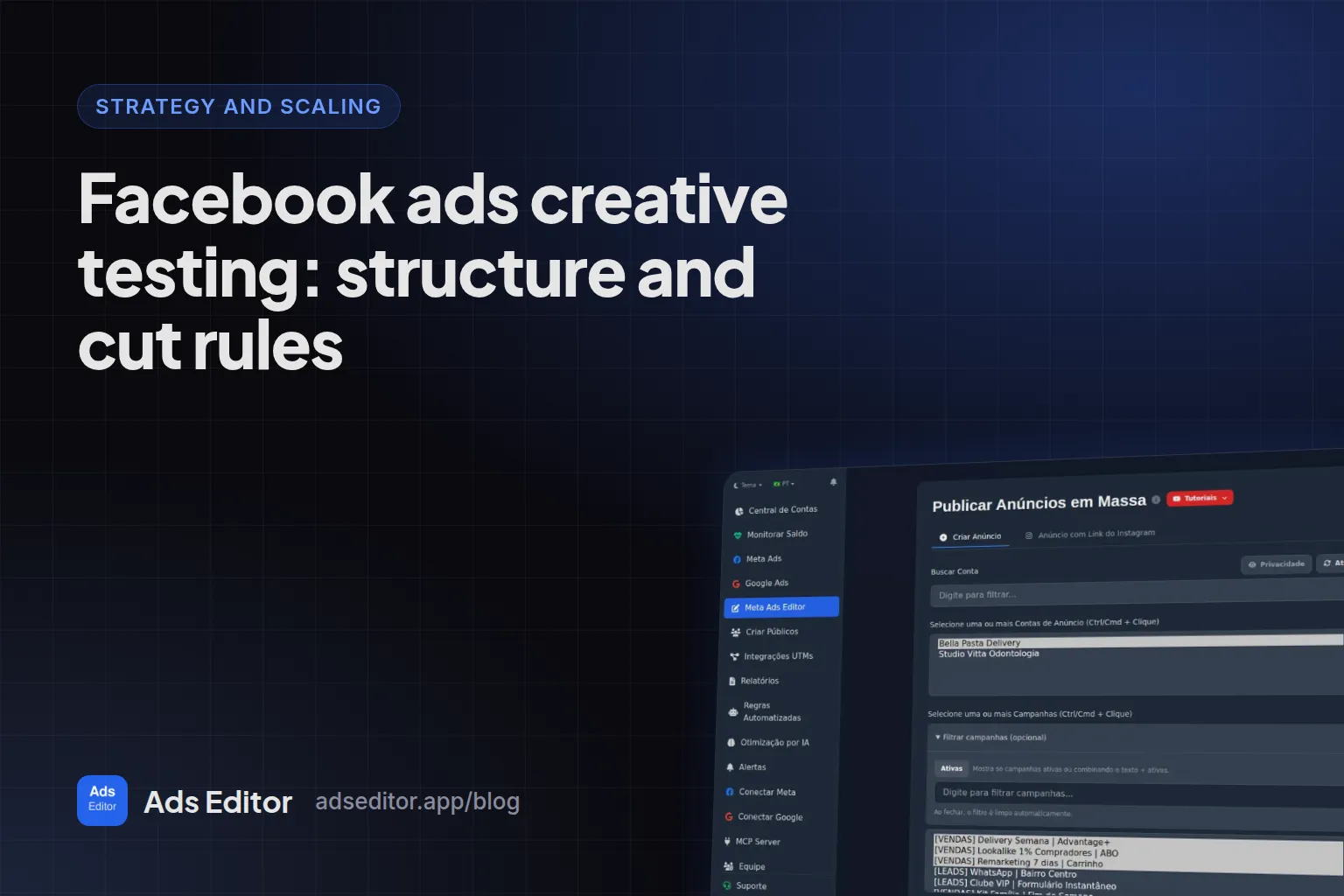
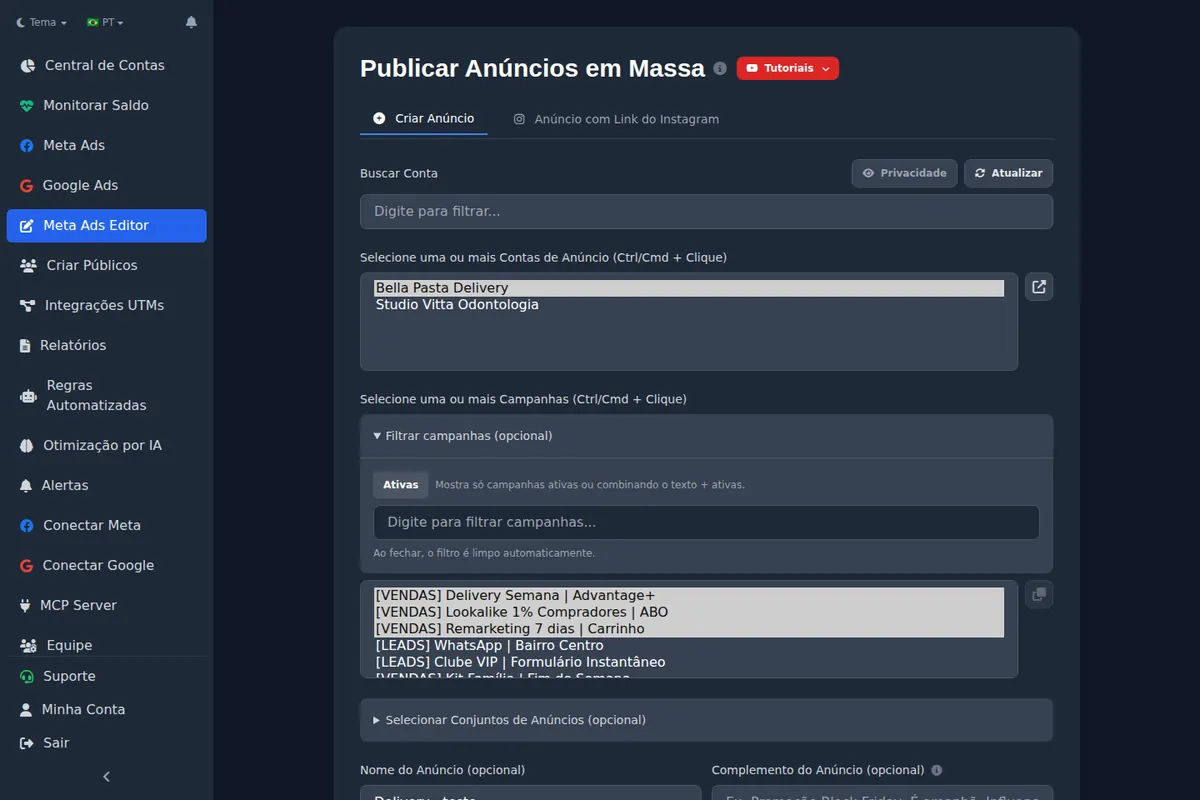
In Ads Manager, you build every variation by hand, one ad at a time. In Ads Editor, the whole test goes out in one pass through bulk publishing:
- Create (or copy) the test campaign in ABO, with the ad sets already set to the threshold budget.
- In bulk publishing, pick the account, the campaign and the test ad sets.
- Drag in every variation at once. Copy, headline, URL and UTMs are set once for the whole batch.
- Use the ad name to flag the variable being tested (hook A, hook B), so the report reads at a glance.
- Publish them paused, spot-check one ad in Ads Manager, then turn them all on together so every variation starts at the same moment.
How does an automated rule pause the loser?
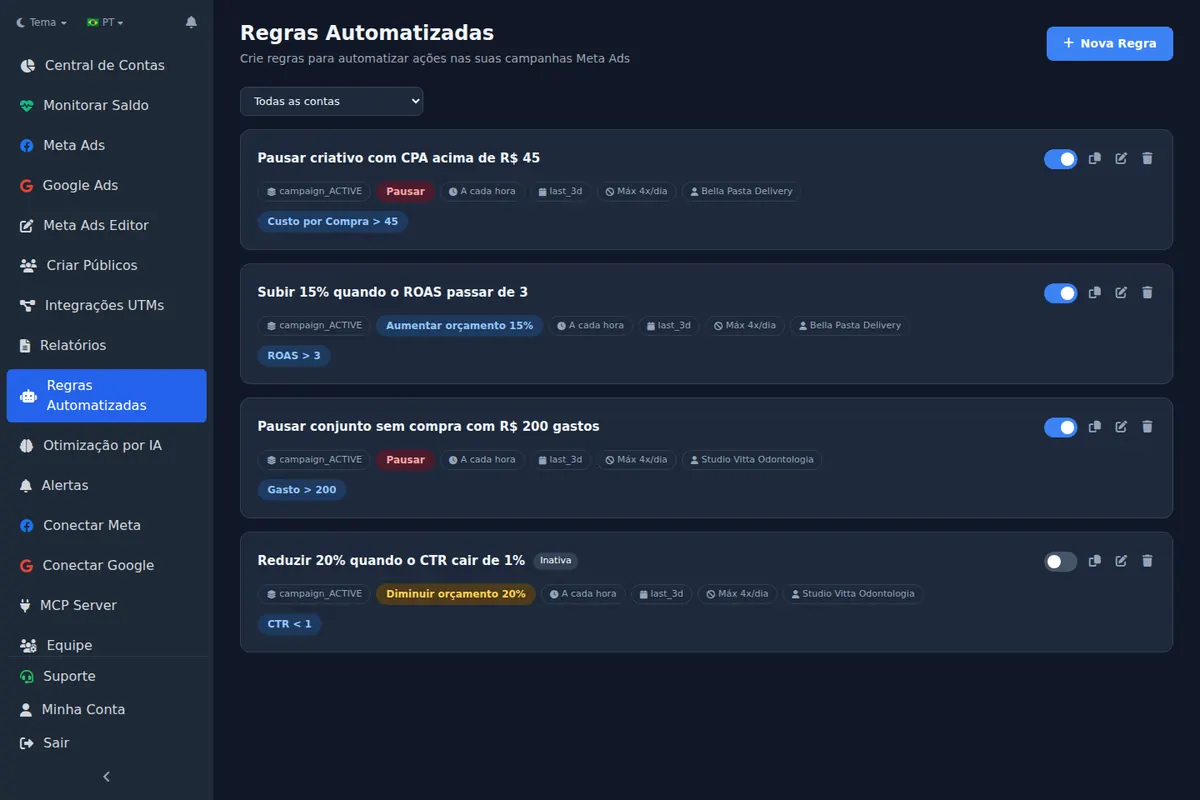
Once the threshold is written down, the cut becomes a rule. In Ads Editor, build a rule at the ad level, scoped to the test campaign's name:
- Condition: CTR below 1% and impressions greater than or equal to 3,000. The rule reads Meta's CTR (all), which runs higher than link CTR; that is why the floor here is 1%, not 0.5%. Adjust it to your account's average. Without the minimum impressions, the rule pauses whatever happened to have one bad hour.
- Second rule: spend greater than or equal to 2x target CPA and no results. That is the conversion cut from the list above.
- Date range: the last 3 days, including today, to cover the 48 to 72 hour window.
- Action: start with Notify only. Once the rule stops throwing false positives, switch it to Pause.
Hook and hold rate are not rule conditions; they are tracked by the creative Health Score, available on the Business plan and up. More templates and the date range trap are in Meta Ads automated rules.
What are the most common creative testing mistakes?
- Editing an ad or its budget during the read window.
- Testing creative and audience at the same time.
- Turning the variations on at different times.
- Holding video and image to the same hook threshold.
- Scaling inside the test campaign.
What do you do with the winner?
Do not scale inside the test campaign: raising the budget there changes the comparison itself. Move the winner into a scaling campaign, in CBO if there is enough conversion volume for it, and keep testing the next round in the test campaign. The path is in how to scale Meta Ads campaigns.
Move the winning ad using the existing post instead of rebuilding it: the likes and comments it has already racked up come along with it and help conversion.
Winners wear out too. Frequency above 3 with CTR dropping 3 days in a row is a fatigue signal: have the next round ready before you pause. Launching a new round every week keeps replacements in the pipeline. In reach or ThruPlay campaigns you can also set a ceiling per person on the ad set itself: see Facebook ads frequency cap.
If what you want is to let Meta mix copy and media on its own instead of testing variation by variation, that is a different format with a different read: see Meta flexible ad format.
Frequently asked questions
How do you test creatives in Meta Ads?
An ABO campaign, 3 to 5 variations per round, about 2x target CPA per day in each ad set and a first read at 48 to 72 hours, cutting whatever falls below the hook, hold and CTR thresholds.
How many creatives should go in each test ad set?
One per ad set gives the cleanest read. If the budget does not allow it, 3 to 5 in the same ad set, knowing Meta will deliver them unevenly.
How long should a creative run before I pause it?
48 to 72 hours to cut a clear loser. To declare a winner, wait for at least 10 conversions per variation and 5 to 7 days of delivery.
Does creative testing work in CBO?
Not well: CBO concentrates budget on whatever looks best in the first few hours, and the other variations barely run. For testing, use ABO.
How do you test creatives on a small budget?
Cut the round to 2 or 3 variations, decide on an indicator upstream of purchase (link click, initiated checkout) and give it 7 more days before crowning a winner. A gap of 1 or 2 conversions is noise.
Glossary
- Creative test
- A controlled comparison of ad creatives where only one variable changes between variations.
- Variation
- One version of a creative that differs from the others in a single element, such as the opening.
- Winner
- The variation that keeps the best cost per result with enough conversion volume to trust it.
- Link CTR
- Link clicks divided by impressions; it is lower than CTR (all), which counts any click on the ad.
References
- Flexible Ad Format: Why I Use It and How You Can Too (Jon Loomer). Supports: States that Flexible Ad Format is not meant for split testing and that Meta's breakdown by image or video does not work with it, so you cannot tell which creative version performed best.
The claim supported by each source is shown above.
About the author
Matheus Mello, founder of Ads Editor and owner of YEP Agência. Runs client ad accounts at YEP Agência and built Ads Editor so his own agency could stop publishing ads one at a time. Usage numbers quoted on the blog come from the product activity log. Instagram: @theusm