How to scale Facebook ads without resetting learning
By Matheus Mello, founder of Ads Editor and owner of YEP Agência · Published · 10 min read
How to scale Facebook ads is usually answered with the 20% rule: raise the budget by no more than 20% every three or four days. We run accounts differently, in budget steps of up to 35% that can be repeated back to back, with a re-evaluation every 2 to 4 hours, and this guide explains the method, the math and the safeguards.
Quick answer
To scale Facebook ads without resetting learning, raise the budget in steps of up to 35%, which can be repeated in sequence within the same minute, and re-evaluate every 2 to 4 hours: if results hold, step up again; if they drop, hold or cut. Avoid the single large jump, such as doubling the budget in one edit.
Summary
- What resets learning is the single large jump, not a sequence of moderate steps.
- Steps of up to 35% can be chained; above roughly 38% an increase starts to behave like a big edit.
- Re-evaluate every 2 to 4 hours and let the results of that window decide the next step.
- For digital products with instant revenue data, the daily budget can follow sales x average order x k.
- Scaling needs a written daily ceiling, one automation per budget and a stop-loss.
What actually resets the learning phase when you scale?
An ad set that exits learning has found a cheap path to its optimization event. What throws it back into learning is a single large jump, such as doubling the budget in one edit. In our operation, a sequence of steps of up to 35% does not reset learning, even when the steps add up to more than 100% in the same day.
Meta has never published a precise threshold. Its own documentation example, quoted by Jon Loomer, only says that going from $100 to $101 is unlikely to restart learning while going from $100 to $1,000 may. Jon also reported Meta recommending, inside Ads Manager, a raise from $100 to $179 (79%) without reentering learning. The popular 20% rule is a safe convention, not a Meta rule.
How much should you increase the budget at a time?
Up to 35% per step. The practical limit sits near 38%: above that, the increase starts to weigh like a big edit. And the step can be repeated in sequence, in the same minute, without waiting days between one and the next. That is how we run accounts that scale to five-figure daily budgets.
| Step | Daily budget |
|---|---|
| Start | $250.00 |
| Step 1 (+35%) | $337.50 |
| Step 2 (+35%) | $455.63 |
| Step 3 (+35%) | $615.09 |
| Step 4 (+35%) | $830.38 |
| Step 5 (+35%) | $1,121.01 |
Five steps, one after the other, take a campaign from $250 to $1,121 a day, more than four times the starting budget, without the single jump that resets learning. If you have a day with room to spend, you do not wait two days between increases.
How often should you re-evaluate during the day?
Every 2 to 4 hours. If the result holds or improves, run another sequence of steps of up to 35%. If it gets worse, hold the budget or cut it. The results of the window decide the next step, not a fixed clock between increases.
How do you set the daily budget from revenue?
There is a method used by digital product sellers who scale on same-day revenue, and it is the rule we have used since 2023: the day's budget comes from revenue already booked. The math is today's sales x average order value x k, and k depends on ROAS:
| Same-day ROAS | k (revenue multiplier) |
|---|---|
| Close to 2 | x 5 |
| 1.7 to 1.9 | x 4 |
| Below 1.7 | x 3 |
Example
11 sales at $100 add up to $1,100 in revenue. With a ROAS of 1.99, k is 5, and the day's budget goes to $5,500.
The budget here is an open ceiling, not a spend target: the campaign spends what the auction delivers inside it. Check it in the morning and at night, and kill the same day any campaign that does not sell.
When does the revenue method make sense?
- Digital products with revenue measured per sale and immediate results: each sale is recorded the minute it happens, from your checkout (Stripe, Shopify, Kajabi, Teachable, ClickFunnels or similar) or through UTM tracking, with dashboards that compute profit in near real time.
- High margins, where a ROAS near 2 still leaves profit.
- Enough cash to absorb a bad day without hurting the business.
- Ecommerce and supplements can use it on one condition: know product cost and net profit in near real time, and respect a break-even ROAS. Digital products do not carry those costs; physical goods do, and multiplying revenue below break-even multiplies the loss.
When should you not use it?
- When a sales team closes later: same-day revenue does not reflect what the campaign generated, and the budget would be stuck near zero while the team closes.
- High-ticket offers: few sales a day, each weighing a lot, so sales x order value x k swings too much to set budget hour by hour.
- Lead and messaging campaigns, which have no per-sale revenue to multiply.
Vertical or horizontal scaling: which one?
| Type | What it is | When to use it |
|---|---|---|
| Vertical | Raise the budget of what is already running, in steps of up to 35% | A campaign with conversion volume and cost within target |
| Horizontal | More creatives and more campaigns pointing at the same broad audience | When the running campaign no longer absorbs budget at the same cost, or to change structure (ABO to CBO) without touching the original |
Most advertisers who scale today are on Advantage+ and broad audiences. So horizontal scaling stopped meaning slicing the audience into pieces: it means feeding the algorithm more creative and opening more campaigns on the same audience. Copying campaigns within or across accounts is the tool for that duplication.
Does the structure matter: ABO or CBO to scale?
The operating consensus is to test in ABO and scale in CBO, with numbers attached: CBO needs roughly 50 conversions per week per ad set, ideally 150 across the campaign, to allocate with signal. Below that it decides in the dark. The full article is CBO vs ABO, and the minimum budget math per ad set is in Facebook ads learning phase budget.
When should you kill instead of scale?
Scaling without cut rules burns money. The rules we use:
- CTR below 0.5% with enough impressions is a candidate for cutting.
- Frequency above 5 signals decline in ecommerce and digital products, but it is normal for local businesses, where recall matters.
- Hook rate dropping against the previous week warns of fatigue before CTR moves. See hook rate, hold rate and creative fatigue.
Which safeguards does automated scaling need?
1. A written daily ceiling, not a remembered one
Automation without a ceiling keeps climbing while results hold and keeps climbing when they stop holding. Define how much a campaign may grow in a day over its opening budget, and let the re-evaluation decide whether the next step happens.
2. One automation per budget
If a budget rule and an automatic scaler act on the same campaign, one raises and the other cuts, and the campaign lives in learning. Ads Editor arbitrates: on budget actions the scaler wins, and the rule logs in its history that it skipped. Rules that only pause or activate stay free.
3. Rules with minimum volume and the right date range
Every cut rule needs a minimum of spend or impressions, or it pauses an ad that had one bad hour. And check the date range: we measured on Meta's API on August 31, 2026 that the last 3 days preset excludes today. Run on the 31st, it returned the 28th, 29th and 30th. A Monday morning rule on the last 3 days looks at Friday, Saturday and Sunday. In Ads Editor every range says in its name whether it includes today.
| Goal | Condition | Action |
|---|---|---|
| Stop the bleeding | Spend above 1.5x target CPA and 0 purchases, last 3 days including today | Pause the ad |
| Protect CPA | CPA above target and spend above 2x target, last 7 days | Cut budget 20% |
| Push a winner | ROAS above goal and more than 10 purchases, last 7 days | Raise budget 15%, with a daily cap |
| Watch without acting | CTR below 0.5% and more than 5,000 impressions, today | Notify only |
How does automated scaling work in Ads Editor?
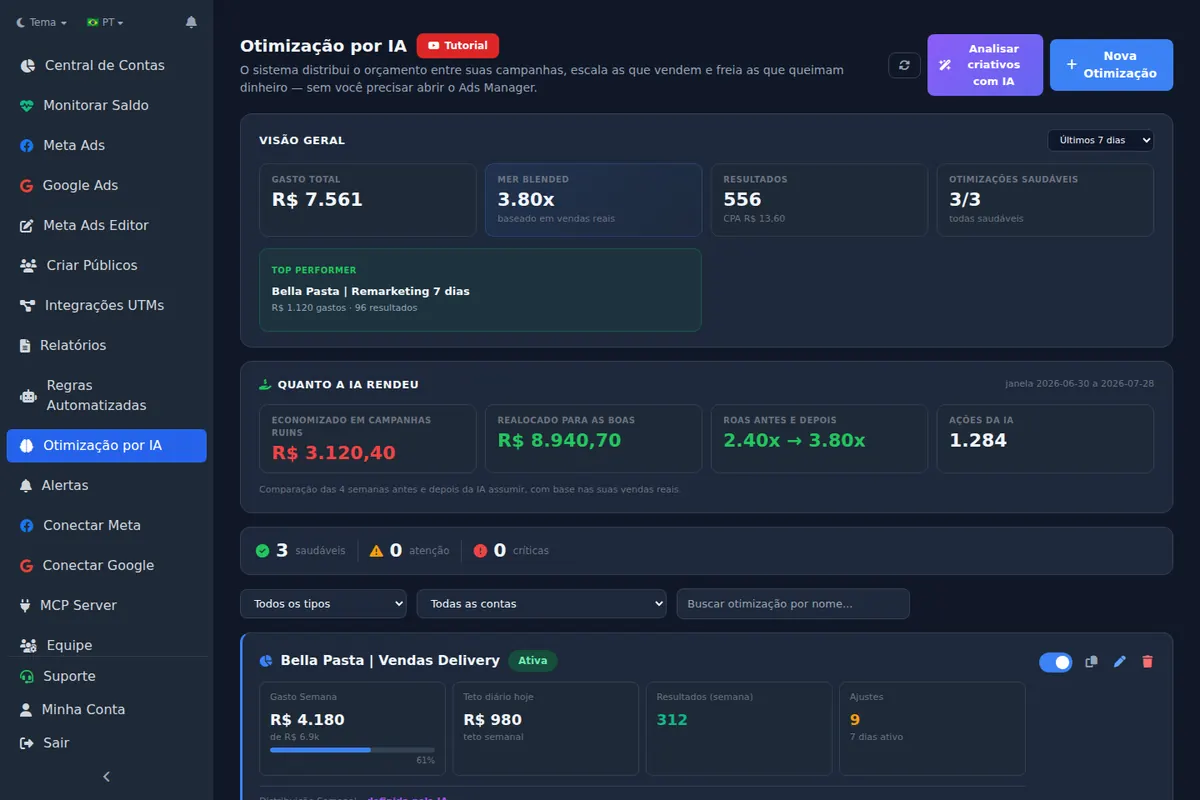
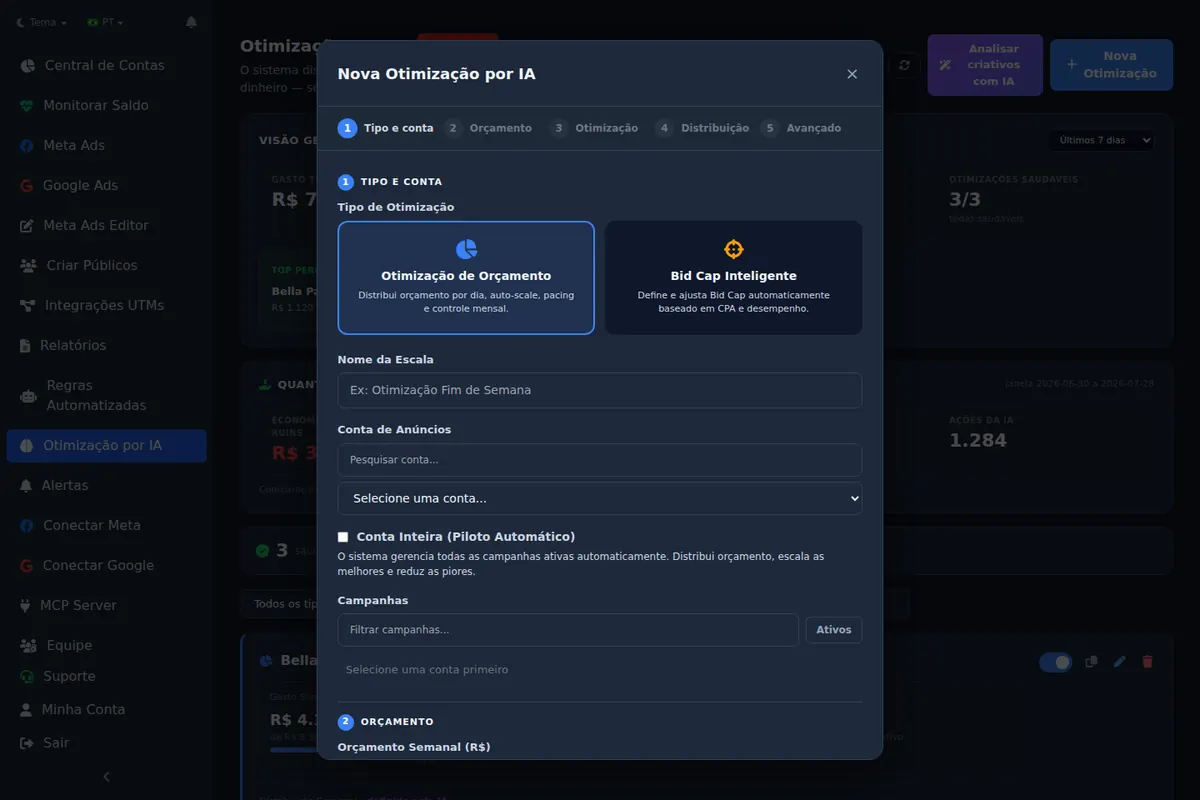
AI Optimization, available from the Business plan up, acts only on the campaigns you put in it and has the safeguards above built in:
- Pace by profile: conservative, moderate or aggressive, with a growth ceiling for the day.
- Budget distribution across the week and the day: even, gradual, weekend or weekdays, plus an hourly curve.
- Pacing: spreads the budget through the day so it does not burn early.
- Stop-loss: pauses automatic scaling if results worsen several days in a row, the defense against a broken pixel.
- ABO and CBO structure advisor: detects when the structure is costing results and suggests the switch. It never switches on its own: it shows the evidence and waits for approval.
- Creative fatigue: warns when an ad starts to tire, before CTR drops.
If machines touching your budget makes you nervous
Do not turn on automatic scaling. Use rules that only notify and scale by hand, with steps of up to 35% and the 2 to 4 hour re-evaluation above. Automation you do not trust is automation you switch off on day two.
Good scaling starts earlier, in testing: how to build the variation batch, how much budget per ad set and when to cut are in Facebook ads creative testing. If Meta offers you the flexible format, what it changes is in Meta flexible ad format.
Frequently asked questions
How much can I increase the budget without resetting learning?
Up to 35% per step; the practical limit is near 38%. Steps can be repeated in sequence in the same minute: what resets learning is the single large jump, such as doubling the budget.
Do I need to wait between increases?
Not between the steps of one sequence. Between one sequence and the next, re-evaluate in 2 to 4 hours and step up only if results held or improved.
How do I set the daily budget from revenue?
Today's sales x average order value x k, with k of 5 for ROAS near 2, 4 for ROAS of 1.7 to 1.9 and 3 below that. It fits digital products with high margins and revenue measured per sale.
Is the 20% rule wrong?
It is safe but slow. Meta has not published a threshold, and its own in-app recommendation has suggested raises of 79% without reentering learning. Chained steps of up to 35% are what we run.
Does automated scaling replace the media buyer?
No. It executes a rule the media buyer defines, with a ceiling and safeguards. Strategy, creative and offer decisions stay human.
Glossary
- Vertical scaling
- Raising the budget of a campaign or ad set that is already working.
- Horizontal scaling
- Adding creatives or campaigns on the same audience to absorb more budget.
- Stop-loss
- A safeguard that halts automatic scaling after several days of worse results.
- Break-even ROAS
- The ROAS at which revenue exactly covers ad spend plus product and fulfillment costs.
- Pacing
- Spreading a daily budget over the hours of the day.
References
- Updates to Meta Ads Budgeting (Jon Loomer). Supports: Quotes Meta's documentation that $100 to $101 is unlikely to restart learning and $100 to $1,000 may, and reports an Ads Manager recommendation to raise $100 to $179 without reentering the learning phase.
- Facebook Ads Edits that Trigger the Learning Phase (Jon Loomer). Supports: Quotes Facebook's definition: the learning phase occurs when you create a new ad or ad set or make a significant edit to an existing one, and performance is less stable during it.
Links opened and checked when the article was last updated.
About the author
Matheus Mello, founder of Ads Editor and owner of YEP Agência. Runs client ad accounts at YEP Agência and built Ads Editor so his own agency could stop publishing ads one at a time. Usage numbers quoted on the blog come from the product activity log. Instagram: @theusm