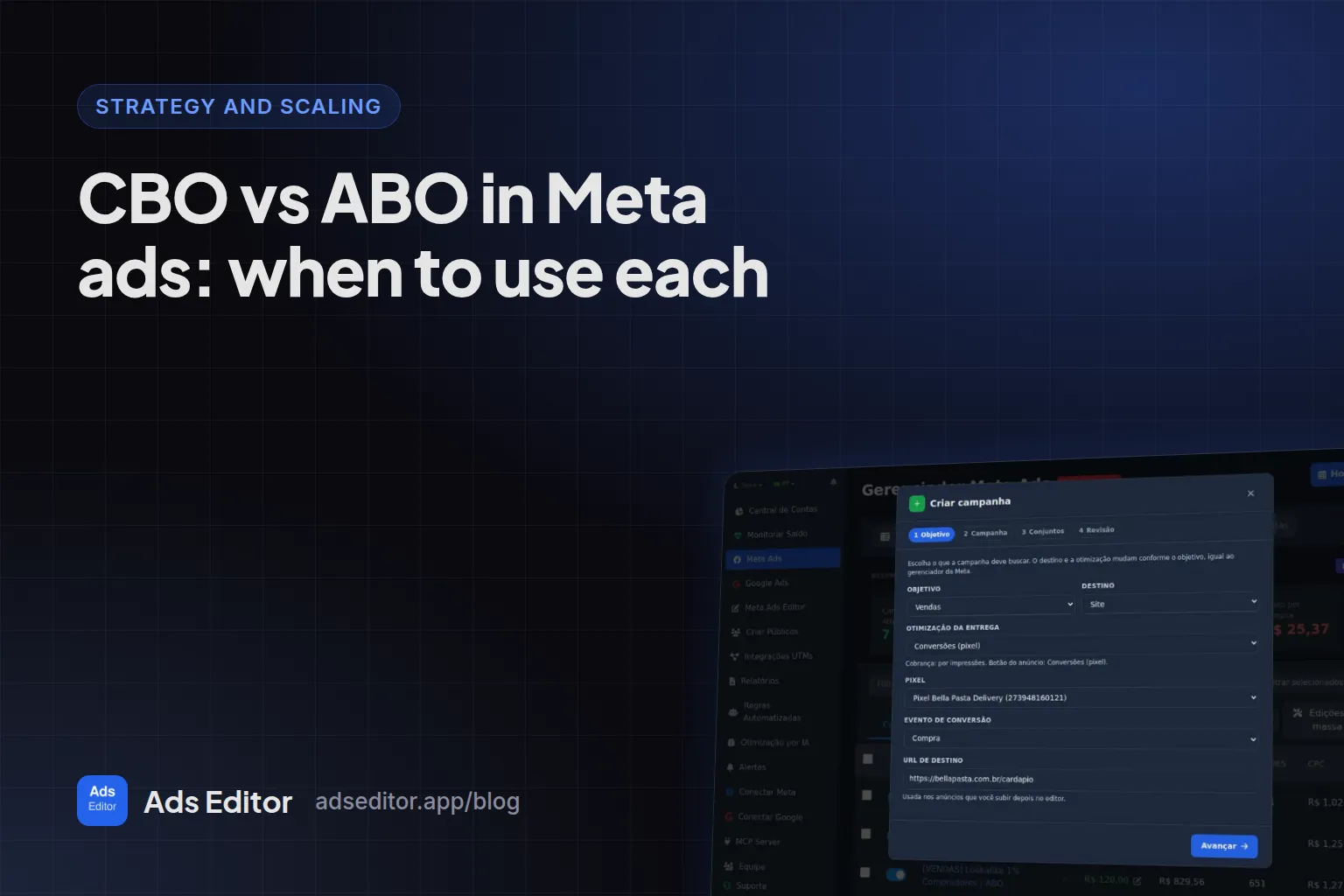
CBO vs ABO in Meta ads: when to use each
By Matheus Mello, founder of Ads Editor and owner of YEP Agência · Published · 5 min read
CBO vs ABO is the oldest structure debate in Meta ads, and the 2026 answer is still test in ABO, scale in CBO. What most guides skip are the numbers behind that rule, the documented limits of each structure and what it really costs to switch a campaign that is already running.
Quick answer
Use ABO to test audiences, creatives or regions with a clean read per ad set, and CBO to scale a validated concept across 3 to 7 similar ad sets. CBO needs roughly 50 conversions per week per ad set to allocate well. For a campaign that is already running, duplicate into the new structure instead of converting it.
Summary
- ABO (ad set budget) fixes spend per ad set; CBO (Advantage campaign budget) lets Meta move budget between ad sets in real time.
- ABO wins for testing, small budgets and audiences with very different economics.
- CBO wins with volume: 50+ conversions per week per ad set and ideally 150+ per campaign.
- A campaign with more than 70 ad sets on Advantage campaign budget cannot turn it off.
- We measured that Meta only accepts a new CBO toggle about 2 hours after the previous one.
What are ABO and CBO?
| Term | Current name at Meta | What it does |
|---|---|---|
| ABO | Ad set budget | You fix how much each ad set spends |
| CBO | Advantage campaign budget | One budget at campaign level; Meta distributes it across ad sets in real time |
| Budget sharing | Ad set budget sharing | ABO with a layer of CBO: Meta can share up to 20% of one ad set's budget with others |
New Advantage+ campaigns start with campaign budget selected by default, so the real decision is when to override that default, not whether ABO still exists.
When does ABO win?
- You are testing concepts, audiences or regions and need a clean read per ad set.
- The total budget is too small to feed several ad sets. Concentrate on one ad set in ABO.
- The audiences have very different economics, such as retargeting and a broad audience. In CBO, the larger one tends to starve the smaller.
- Each ad set gets fewer than about 50 conversions per week.
When does CBO win?
- The concept is validated and you want to scale it across 3 to 7 similar ad sets.
- There is volume: 50+ conversions per week per ad set and, ideally, 150+ across the campaign.
- You are going to raise spend: the increase spreads across several ad sets instead of pushing one back into learning.
Illustrative scenario (not a real client)
A campaign has five ad sets and a $250 daily campaign budget. Meta may spend $150 on one ad set, $60 on another and almost nothing on the rest. That is CBO working as designed for scale, and exactly why it is a poor tool for a fair test.
Which limits of each structure change how you operate?
Budgets flex above the daily amount
Meta can spend above a daily budget on days with better opportunities. Jon Loomer documented the change from up to 25% to up to 75% over the daily budget, while the week stays capped at seven times the daily amount. If the client counts every dollar, explain this before launch.
The 70 ad set limit
Per Meta's developer documentation, a campaign with more than 70 ad sets on Advantage campaign budget cannot change its bid strategy or turn off the campaign budget. If you might go back to ABO one day, do not let the campaign balloon.
A third detail, measured through Meta's API by Ads Editor: after turning CBO on or off in a campaign, Meta only accepts another switch about 2 hours later.
Should you convert a campaign that is already running?
This is where the market genuinely disagrees. Changing the budget structure is a significant edit: the campaign goes back into learning. Some sources say never convert, and duplicate the winners into a new campaign already built the right way; others treat conversion as a normal operation, since Meta exposes it in the interface and the API.
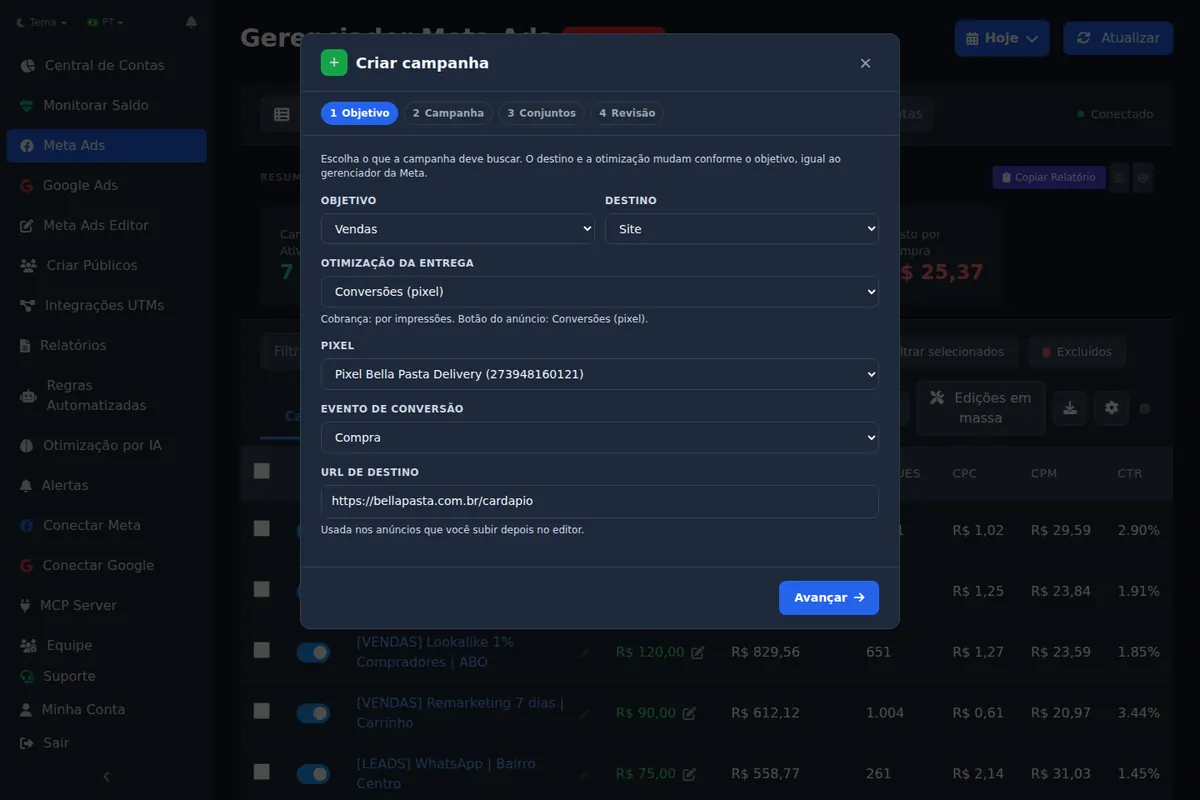
Our position, which is how the product behaves: the switch should never be automatic. The Ads Editor structure advisor suggests the switch, shows the number that triggered it and warns about the learning cost. The media buyer approves. To duplicate instead of converting, use a campaign copy.
How do CBO and ABO fit into testing and scaling?
Test in ABO, because each variation gets the budget you set and the comparison is fair: Facebook ads creative testing has the structure. Scale the winner in CBO once there is conversion volume, raising the budget in steps: the method is in how to scale Facebook ads.
Frequently asked questions
Is CBO better than ABO?
Neither is always better. ABO wins for testing and small budgets; CBO wins for scaling a validated concept with conversion volume.
How many ad sets should a CBO campaign have?
Between 3 and 7 similar ad sets is the typical range.
Does switching from ABO to CBO reset learning?
Yes. Changing the budget structure is a significant edit. That is why many media buyers duplicate the winner into a new CBO campaign.
What is Advantage campaign budget?
It is Meta's current name for CBO: a single campaign budget that the algorithm distributes across ad sets.
What is ad set budget sharing?
An option inside ABO that lets Meta share up to 20% of an ad set's budget with other ad sets in the campaign when it expects better results.
Glossary
- ABO
- Ad set budget optimization: each ad set has its own fixed budget.
- CBO
- Campaign budget optimization, now called Advantage campaign budget.
- Budget sharing
- An ABO option that lets Meta move up to 20% of an ad set's budget to other ad sets.
- Learning phase
- The period after launch or a significant edit when delivery is still being optimized and costs are less stable.
References
- Advantage campaign budget (Meta for Developers). Supports: A campaign with more than 70 ad sets that uses Advantage campaign budget cannot edit its bid strategy or turn off Advantage campaign budget.
- Ad Set Budget Sharing (Jon Loomer). Supports: The checkbox reads that Meta will share up to 20% of your ad set budget with other ad sets in the campaign when it is likely to improve performance.
- Updates to Meta Ads Budgeting (Jon Loomer). Supports: Meta may spend up to 75% over the daily budget on days with better opportunities, up from 25%, without exceeding seven times the daily budget over a week.
Links opened and checked when the article was last updated.
About the author
Matheus Mello, founder of Ads Editor and owner of YEP Agência. Runs client ad accounts at YEP Agência and built Ads Editor so his own agency could stop publishing ads one at a time. Usage numbers quoted on the blog come from the product activity log. Instagram: @theusm