Meta Andromeda: how ad retrieval works and what it changes for creative
By Matheus Mello, founder of Ads Editor and owner of YEP Agência · Published · 12 min read
Meta Andromeda is Meta's ad retrieval system: the stage that decides which ads compete for a given person before any ranking or auction happens. It changed fewer buttons than it changed the logic of creative, and much of what you read about it is the market's interpretation, not Meta's own words.
Quick answer
Meta Andromeda is Meta's retrieval system: out of tens of millions of ads, it narrows the field to a few thousand candidates for each person before ranking. Ads that look very similar are treated as variations of the same creative. So launch genuinely different concepts, in a simple structure, instead of dozens of micro-variations.
Summary
- Andromeda is the first stage of delivery: it retrieves candidates before ranking and the auction. Meta's engineering team introduced it in December 2024.
- In a December 2025 post, Meta confirms that ads that look alike are seen as variations of the same creative and share learning.
- "Entity ID" is not an official Meta term: it is the name the market gave to that grouping.
- Count concepts, not files: a different pain point, proof, offer, persona or format counts; a new color or caption does not.
- A simpler structure (fewer ad sets, broader audience) lets the system choose among more distinct creatives.
- Meta does not publish a minimum number of creatives. Anyone quoting a number is giving you their own rule of thumb.
What is Meta Andromeda?
It is the machine learning system Meta uses for ad retrieval. Meta's delivery happens in several stages. In the first one, retrieval, the system scans the ad inventory and pulls out a small group of candidates for that person, at that moment. Only those candidates move on to the ranking models, which estimate value for the person and for the advertiser, and from there to the auction.
The Meta engineering post that introduced Andromeda, published on December 2, 2024, describes the scale: retrieval selects a few thousand candidates out of tens of millions of ads for the models that follow. An ad that does not make it through this filter never reaches the auction, however good its bid.
| Stage | What happens | Where Andromeda fits |
|---|---|---|
| Retrieval | Out of tens of millions of ads, a few thousand candidates remain | Right here. Andromeda is the engine of this stage |
| Ranking | Larger models estimate the chance of action and the value of each candidate | Receives whatever Andromeda let through |
| Auction | Bid, estimated action rate and quality decide who shows up | Not Andromeda, but only retrieved ads compete |
What does Meta say officially, and what is market interpretation?
It is worth separating the two before you change the account, because a lot of the advice about Andromeda blends them together.
| Claim | Source | How to treat it |
|---|---|---|
| Andromeda is the retrieval system, the first stage of ad recommendation | Official: Meta engineering post, Dec 2024 | Fact |
| It runs on Facebook and Instagram and, in Meta's tests, delivered +6% recall in retrieval and +8% ad quality on selected segments | Official: same post | Meta's own number, with no methodology open to advertisers |
| It was built because creative volume grows with Advantage+ and generative AI tools | Official: same post | Fact |
| Ads that look alike are seen as variations of the same creative, and learning and delivery optimization are shared among them | Official: Meta for Business, Dec 2025 | Fact. It is the basis of everything said about diversity |
| Each group of similar ads gets an "Entity ID" | Market. The term does not appear in either Meta text | A useful metaphor, not a documented mechanism |
| Andromeda punishes accounts with similar creatives by raising CPM, or there is an official similarity score visible to advertisers | Market, with no Meta source we could find | Do not base decisions on it |
| You need 10, 15 or 20 creatives per campaign | Market. Meta does not publish a number | The author's rule of thumb, not Meta's |
Andromeda is not the whole algorithm
Performance drops are often blamed on Andromeda by reflex. It is one stage. Broken tracking, a weak offer, fatigue and a pricier auction are still more common causes, and none of them is solved by adding creatives.
Why do similar creatives count as one?
Because, according to Meta itself, when several ads look or sound the same, they are treated as variations of the same creative, and learning and delivery optimization are shared at that level. In practice, ten versions of the same video with a different caption color do not give the system ten options to show ten kinds of people. They give it one option, repeated.
Meta separates two concepts in the same post. Iteration is refining an asset: same image, different copy; same video, different call to action. Diversification is creating distinct pieces, designed for different personas or use cases, that vary in visuals, mood, story and message. Both have their place. The mistake is calling iteration diversification and believing the account has variety.
What counts as a different concept?
| Counts as a new concept | Does not count (it is iteration) |
|---|---|
| A patient testimonial video shot on a phone | The same testimonial with a different caption |
| A practitioner explaining the procedure to people afraid of pain | The same video cut to 15 s instead of 30 s |
| A static offer ad showing the consultation price in $ | The same static ad on a blue background instead of green |
| A before and after carousel | The same carousel with the cards in a different order |
| Behind the scenes at the clinic, speaking to people who have never had the procedure | The same behind the scenes video with different music |
A simple test: describe the ad in one sentence without mentioning color, font or edit. If two ads share the same sentence, they are the same concept.
What changes for media buyers?
The lever moved. Before, much of the work was slicing audiences: interests, age, 1% lookalikes. With retrieval choosing candidates per person, creative variety becomes what gives the system options for different audiences inside one broad ad set. Creative has become targeting, too.
- The brief changes. Instead of asking for "5 variations of the video that worked", ask for 3 to 5 different angles: pain, proof, objection, offer, behind the scenes.
- Production changes. One good piece of raw footage yields several iterations, but only one concept. Plan concepts before you plan edits.
- Analysis changes. Compare concepts with each other, not files. A concept with five micro-variations is not being tested five times.
- Hook testing still matters, just later: first find the concept, then swap the first seconds of the winner, as in creative testing on Meta Ads.
How many creatives should you put in a campaign?
Meta does not publish a number. The official post on diversification recommends a broad portfolio of assets, with more creative freedom across text, image and video, built for several personas, and stops there. The figures of 10 to 20 creatives you see around are rules of thumb from agencies and tools.
In our operation, we count concepts, and the number depends on the phase:
| Phase | How many | Why |
|---|---|---|
| Test round | 3 to 5 concepts per round | More than that dilutes the budget and none gets enough impressions to be judged |
| Scaling campaign with budget and production capacity | A structure we call 1-1-15: one campaign, one broad ad set and 15 to 20 ads | Gives the system distinct options without fragmenting learning across several ad sets |
| Small budget or small production | Fewer ads, all from different concepts | Three distinct concepts give the system more choice than ten versions of the same one |
The practical limit is not the algorithm, it is the budget: every ad needs impressions to be read. At $100 a day, 20 ads barely get off the ground. The budget math per test ad set is in creative testing on Meta Ads.
Does your account structure need to get simpler?
Generally, yes, and this is where market advice lines up with the direction Meta points to when it recommends Advantage+. Many small ad sets, each with one interest, split budget and conversion signal; each one learns alone and slowly. Fewer ad sets, with broader audiences and more concepts inside, concentrate learning.
- Consolidate ad sets that do the same job. Three ad sets with similar interests for the same product usually become one.
- Keep apart what has different economics. Retargeting and broad prospecting, or two products with very different price points, stay separate.
- Separate testing from scaling. Test in ABO for a clean read; scale in CBO, as in CBO vs ABO.
- Local businesses are a partial exception. A small geographic radius is already a narrow audience; opening up interests there changes little. What changes is creative variety.
What about Advantage+?
Andromeda was introduced alongside Advantage+ automation: in the engineering post, Meta says Advantage+ and generative AI increase the number of creatives in the system, and that retrieval had to keep up. In the diversification post, Meta recommends Advantage+ campaigns and cites an internal figure: advertisers who were not using Advantage+ sales campaigns saw, on average, 22% higher ROAS when they turned on AI targeting.
Read that number for what it is: Meta's own data, with no period, niche or country breakdown disclosed. Advantage+ tends to work better when the account has conversion signal and creative variety for Meta to choose from. Without both, it automates the choice among very few options.
What are the most common mistakes after Andromeda?
- Confusing volume with diversity. Twenty files, two concepts. The account looks full and the system sees very little.
- Testing format before testing concept. 9:16 against 4:5 of the same video is an iteration test. Find out which message works first.
- Broadening the audience without broadening the creative. A broad audience with a single concept shows the same ad to everyone. The two changes go together.
- Spreading a few concepts across many ad sets. It fragments the learning that consolidation was meant to concentrate.
- Launching 20 ads with budget for 4. The ones that get no impressions did not lose: they were never tested.
- Blaming Andromeda for every drop. Check tracking, offer, frequency and CPM before rebuilding the structure.
How do you build creative volume without becoming hostage to production?
Treat creative as a calendar, not an emergency. A routine that works in our operation:
- List the client's personas and objections. For an online course: people afraid they will not have time, people who bought a course before and never finished it, people who want proof of results. Each one becomes a concept.
- Pick one format per concept. Testimonial, demo, behind the scenes, static offer, carousel. A different format helps the system tell them apart, but the concept comes first.
- Produce 3 to 5 concepts per round and test them in ABO with a set budget.
- Iterate only the winner. Change the opening, the copy and the call to action of the winning concept, and move it to the scaling campaign.
- Replace before fatigue. The refresh pace by business type (12 days for digital products, 18 for ecommerce, for example) is in hook rate, hold rate and creative fatigue.
Illustrative example: a fashion ecommerce store
Instead of 12 photos of the same dress on different backgrounds, the round carries: a fitting room video shot by a customer, a static offer ad with free shipping, a carousel of work outfits, a video of the founder explaining how she picks the fabric and a testimonial about fit. Five concepts, five different reasons to buy.
How do you launch several concepts at once in Ads Editor?
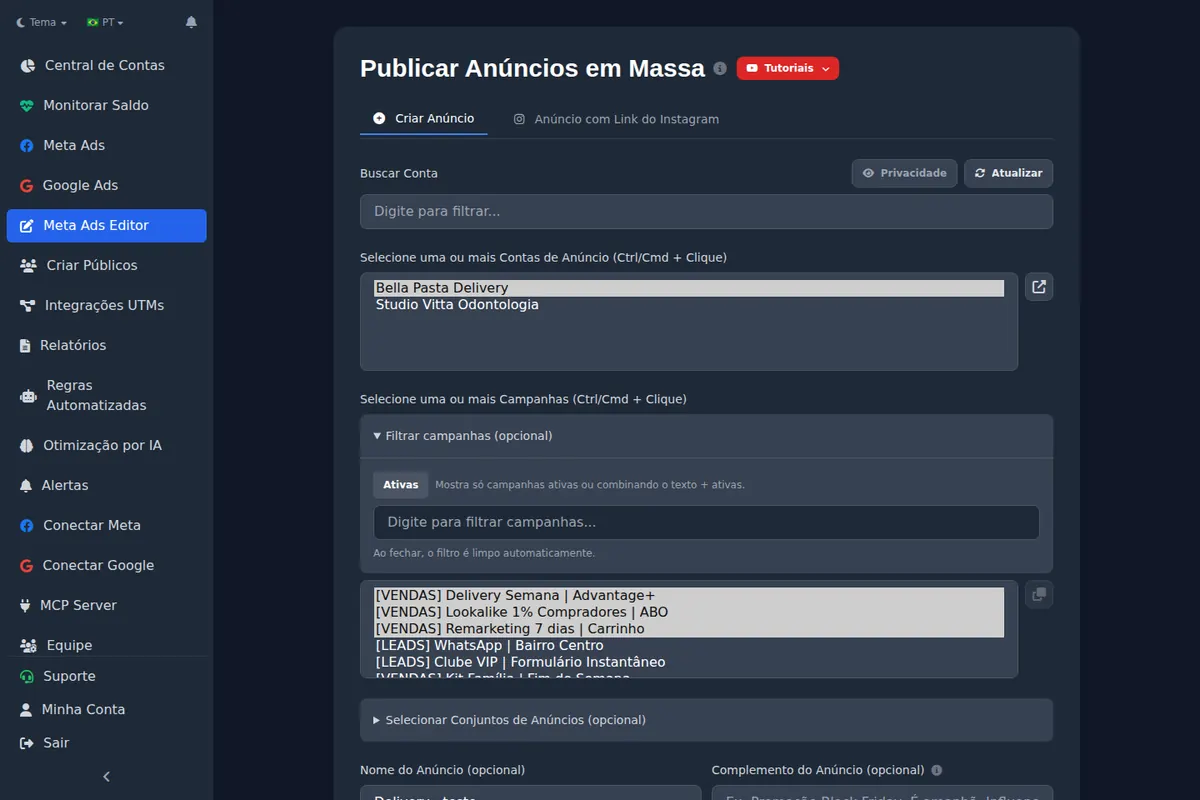
More concepts per round means more ads to upload, and in Ads Manager each one is a manual, laborious process. With bulk publishing in Ads Editor, the whole batch goes out in one action:
- In bulk publishing, pick one or more accounts, the campaigns and, if you want, the target ad sets.
- Drag the creatives for every concept at once, images and videos together. Each creative becomes its own ad, which keeps the read per concept.
- Set copy, URL and UTMs once for the batch, using the account's UTM default.
- Leave the status as Paused, check one ad and activate the batch together, so every concept starts at the same time.
- Name each ad after its concept (pain-time, proof-testimonial), so the report compares concepts, not files.
The full walkthrough, including the limits of Meta's spreadsheet import, is in how to bulk upload Meta ads.
Frequently asked questions
What is Meta Andromeda?
It is Meta's ad retrieval system, introduced in December 2024: out of tens of millions of ads, it narrows the field to a few thousand candidates for each person before ranking and the auction.
Is Entity ID an official Meta term?
No. Meta says very similar ads are treated as variations of the same creative; "Entity ID" is the name the market gave to that grouping, and it does not appear in the official texts we read.
How many creatives do I need after Andromeda?
Meta does not publish a number. In our operation, 3 to 5 concepts per test round and 15 to 20 ads in one broad ad set for scaling, when there is budget for each one to get impressions.
Does changing an ad's color or copy count as a new creative?
For Meta, that is iteration: ads that look alike are seen as variations of the same creative. A new creative changes visuals, story and message.
Do I have to use Advantage+ because of Andromeda?
It is not required. Meta recommends Advantage+, but it performs better when the account already has conversion signal and creative variety to choose from.
Glossary
- Retrieval
- The first stage of Meta's delivery, which selects candidate ads before ranking and the auction.
- Creative diversification
- Creating pieces that differ in visuals, story and message, designed for different personas or use cases.
- Creative iteration
- Refining the same asset by changing copy, edit, color or call to action.
- Entity ID
- A market term, not Meta's, for the group of similar ads the system treats as a single creative.
- Concept
- The core idea of the ad (pain point, proof, offer, persona), described in one sentence without mentioning format.
References
- Engineering at Meta: Meta Andromeda, Advantage+ automation's next-gen personalized ads retrieval engine (Dec 2, 2024). Supports: Andromeda is the ML retrieval system, the first stage of multi-stage ad recommendation; it selects a few thousand candidates out of tens of millions; it runs on Instagram and Facebook with +6% recall and +8% ad quality on selected segments; Advantage+ and generative AI increase creative volume in the system. The post does not mention Entity ID.
- Meta for Business: Demystifying Creative Diversification (Dec 16, 2025). Supports: Difference between iteration and diversification; ads that look alike are seen as variations of the same creative, with shared learning and delivery optimization; recommendation of a broad asset portfolio with no minimum number; recommendation of Advantage+; +22% average ROAS for advertisers who were not using Advantage+ sales campaigns, Meta internal data.
Links opened and checked on Oct 4, 2026.
About the author
Matheus Mello, founder of Ads Editor and owner of YEP Agência. Runs client ad accounts at YEP Agência and built Ads Editor so his own agency could stop publishing ads one at a time. Usage numbers quoted on the blog come from the product activity log. Instagram: @theusm